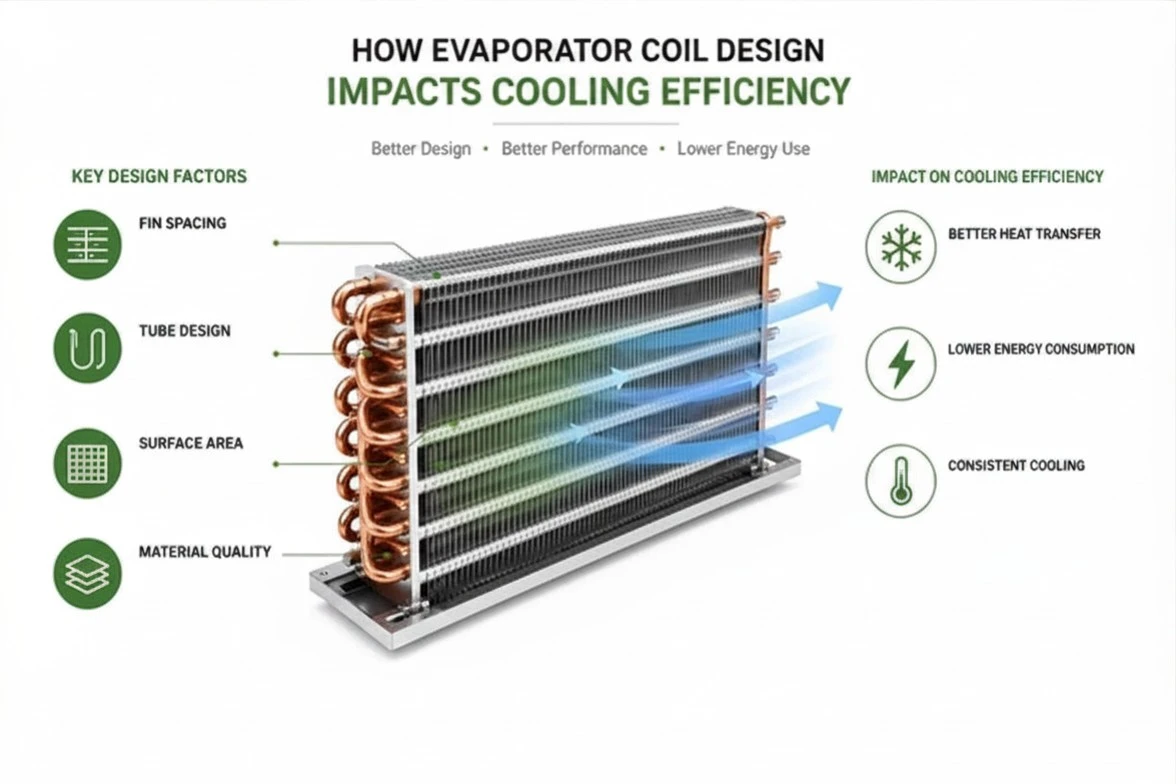
In any refrigeration system, cooling performance depends heavily on the evaporator coil design. Even if a system uses a high-quality compressor or advanced refrigerant, poor evaporator design can reduce efficiency, increase energy consumption, and affect cooling consistency.
That is why modern refrigerator evaporator manufacturers focus not only on the evaporator itself, but also on how the coil is designed, manufactured, and tested. From tube arrangement and fin spacing to material quality and airflow optimization, every detail plays an important role in heat transfer performance.
In this article, we will explain how evaporator coil design impacts cooling efficiency and why proper engineering is critical for reliable refrigeration systems.
Why Evaporator Coil Design Matters
The main function of an evaporator coil is to absorb heat from the surrounding air. The faster and more efficiently this heat is absorbed, the better the cooling performance becomes. However, heat transfer does not depend on refrigerant alone. It also depends on:
- Coil surface area
- Tube diameter
- Fin density
- Airflow path
- Material conductivity
- Coil geometry
- Manufacturing precision
A well-designed evaporator coil improves cooling speed, maintains stable temperatures, and reduces compressor workload. This directly helps lower electricity consumption and increases system lifespan. Poorly designed coils, on the other hand, can create uneven cooling, frost buildup, airflow restrictions, and energy losses.
Heat Transfer Efficiency and Coil Surface Area
One of the most important factors in evaporator coil design is surface area. A larger coil surface allows more heat exchange between air and refrigerant. This improves the overall cooling efficiency of the refrigeration system. Manufacturers increase surface area by:
- Using multiple tube rows
- Adding aluminum or copper fins
- Optimizing fin spacing
- Designing efficient airflow channels
However, increasing surface area alone is not enough. The design must also maintain proper airflow. If the fins are placed too closely together, airflow resistance increases and cooling performance can drop. This is why modern evaporator coil engineering focuses on balancing:
- Maximum heat transfer
- Proper airflow
- Minimum pressure drop
The Role of Fin Design in Cooling Performance
Fins are responsible for increasing the contact area between air and the coil surface. The design of these fins directly affects:
- Heat transfer rate
- Air circulation
- Frost formation
- Energy efficiency
In refrigeration evaporators, fin spacing must be selected carefully depending on the application. Industrial refrigeration systems often require different fin configurations compared to domestic refrigerators because operating conditions are completely different. Proper fin bonding is also extremely important. Weak bonding between tubes and fins reduces thermal conductivity and lowers cooling efficiency.
Tube Design and Refrigerant Flow
Tube configuration is another major factor in evaporator performance. The arrangement of copper tubes affects:
- Refrigerant distribution
- Pressure balance
- Heat absorption rate
- System stability
If refrigerant does not flow evenly through the coil, some sections may cool properly while others remain inefficient. Modern evaporator coils use carefully engineered tube circuits to ensure:
- Uniform refrigerant flow
- Better heat exchange
- Reduced energy loss
- Stable evaporator temperature
Tube diameter also impacts performance. Smaller tubes can improve refrigerant velocity, while larger tubes may reduce pressure drop depending on the system design. This is why evaporator coil manufacturing requires precise engineering calculations instead of generic production methods.
Material Quality and Thermal Conductivity
The quality of materials used in evaporator coils has a direct impact on cooling efficiency. Copper is widely used because of its excellent thermal conductivity, corrosion resistance, and durability. High-purity copper tubes allow faster heat transfer and better refrigeration performance.
Aluminum fins are also commonly used because they are lightweight and provide effective heat exchange. However, low-quality raw materials can create several problems:
- Reduced cooling efficiency
- Corrosion issues
- Refrigerant leakage risks
- Poor durability
- Weak heat transfer
That is why quality-focused HVACR manufacturers perform strict material inspections before production begins.
Importance of Precision Manufacturing
Even a strong evaporator design can fail if manufacturing quality is poor. Small production errors such as:
- Improper tube expansion
- Weak brazing joints
- Uneven fin alignment
- Incorrect tube bending
can reduce the overall performance of the refrigeration system. Precision manufacturing helps ensure:
- Proper refrigerant sealing
- Strong tube-to-fin bonding
- Consistent airflow
- Reliable cooling performance
Advanced manufacturing processes such as CNC tube bending and controlled expansion technology improve production accuracy and reduce defects.
Testing and Quality Control in Evaporator Manufacturing
High-performance evaporator coils must go through strict testing procedures before installation. Common quality control processes include:
- Leak testing
- Pressure testing
- Vacuum testing
- Dimensional inspection
- Brazing quality inspection
These tests help manufacturers identify weaknesses before the product reaches the customer. Without proper testing, even minor defects can lead to refrigerant leakage, reduced cooling capacity, or system failure over time.
How Efficient Coil Design Reduces Energy Consumption
An optimized evaporator coil reduces the workload on the compressor by improving heat absorption efficiency. This leads to:
- Faster cooling
- Lower electricity usage
- Reduced operating costs
- Better temperature stability
- Longer system lifespan
In industrial refrigeration systems where cooling runs continuously, even small efficiency improvements can create significant energy savings over time. That is why modern refrigeration manufacturers are investing heavily in advanced evaporator coil engineering and precision manufacturing technologies.
Optimize Engineering Core – Trusted Expertise in HVACR Manufacturing
At Optimize Engineering Core Pvt. Ltd., we understand that evaporator performance depends on more than basic manufacturing. It requires precision engineering, quality materials, advanced production techniques, and strict testing standards.
Our expertise includes:
- Fin evaporators
- Copper coil evaporators
- Tube expansion technology
- OEM HVACR manufacturing
- Customized refrigeration components
- Quality-tested cooling solutions
To discuss your refrigeration and evaporator manufacturing requirements, contact Optimize Engineering Core Pvt. Ltd. . We focus on manufacturing reliable and high-performance refrigeration evaporators, designed for long-term efficiency and durability. If you are looking for trusted HVACR manufacturing expertise or customized refrigeration components, our team is ready to help.